显示标签为“fiber optic transceiver”的博文。显示所有博文

2012年7月12日星期四

Fiber optic transceiver loopback test


Fiber optic transceiver is the fundamental part in any fiber optic communication network equipment. Its function is exactly the same as your computer’s Ethernet Card. (although almost all modern computers integrate it on the motherboard, not as a separate PCI card anymore)
Fiber optic transceiver has two ports, a transmitter port and a receiver port. The transmitter port sends out laser signal to a linked transceiver and the receiver port receives laser signal from the other transceiver.
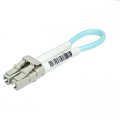
On fiber optic transceiver manufacturing floors and in R&D labs, we usually use a fiber optic loopback module to verify the transceiver is working perfectly as designed instead of using another transceiver as its partner.
Basically what the loopback module does is directly routing the laser signal from the transmitter port back to the receiver port. Then we can compare the transmitted pattern with the received pattern to make sure they are identical and have no error.
What is a loopback test?
A Fiber optic loopback test is a hardware or software method which feeds a received signal or data back to the sender. It is used as an aid in debugging physical connection problems.
What types of Fiber loopback modules are available?
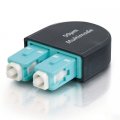
The most popular types of fiber optic loopback modules are SC, LC and MTRJ connector types. But each connector type is divided again by fiber type, connector polish type and attenuation.
    
Fiber Types
Each connector type is available for three fiber types. They are OM2 50/125um multimode, OM1 62.5/125um multimode and 9/125um single mode.
Connector Polish Types
Only PC polish is available for multimode type fibers. But for single mode fiber, two connector polish types are available: UPC polish and APC polish.
Working Wavelength
In addition to fiber type, working wavelength is the other important factor for choosing the correct fiber optic loopback module for your specific application. Available wavelengths are 850nm, 1310nm and 1550nm. 850nm and 1310nm are for multimode applications and 1550nm is for single mode applications.
Fiber optic Attenuation
You can specify how the signal power level should be reduced in the loopback path. This is because the receiver port cannot handle very high power. And in real life fiber optic network, there are always attenuations introduced by fibers, equipment and physical environment. So the transmitter power is attenuated to a safe level through the network before reaching the other receiver.
However since you are routing the transmitter directly back to the receiver, attenuation usually must be added to protect the receiver.
How much fiber optic attenuation should be added depends on your transceiver type and you must decide it by yourself. Fortunately, there are a wide range of attenuation options available from 0dB, 1dB, 2dB to 24dB or even more.
Fiberstore offer fiber lookback module,fiber optic transceiver and other fiber optic products

2012年5月24日星期四

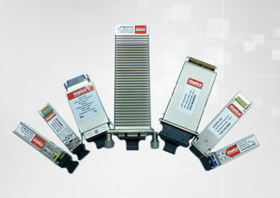
10g sfp+ module compatible cisco from Fiberstore


As we all know,SFP module is the upgrade of the GBIC module.SFP transceiver also know as min-GBIC.
Many people do not know the difference between  sfp module and sfp + module,so sometimes cause unnecessary trouble.10G module has gone 300Pin, XENPAK, X2, XFP development, and finally make 10g signal  transported by sfp size become a reality .10G SFP just is the SFP +.
As a high quality fiber optic patch cords supplier,Fiberstore supply a range of sfp transceiver module incuding single mode SFP, multimode SFP and copper SFP.They’re along with numerous operating wavelength as well as features.Our Cisco SFP+ equivalent products are produced and examined strictly based on industrial standards, they are compatible to the equipment from other companies including Cisco. Cisco SFP+ equivalent products along with DDM function will also be obtainable.
The multi-mode sfp+ transceiver compatible cisco is sfp-10g-sr ,which i s for duplex optical data communications such as 10GBASE-SR and 10GBASE-SW. It is with the SFP+ 20-pin connector to allow hot plug capability. Digital diagnostic functions are available via an I2C. This module is designed for multi-mode fiber and operates at a nominal wavelength of 850nm.
The single mode sfp+ transceiver compatible cisco including sfp-10-lr, sfp-10g-lrm, sfp-10g-er,sfp-10g-zr. (For more information ,you can go to the products page by click the link)
This five products for sale on Fiberstore ,and the products mode are :SFP-10G-SR-FS;SFP-10G-LR-FS;FP-10G-LRM-FS;SFP-10G-ER-FS;SFP-10G-ZR-FS


Advantages of SFP + optical module
1 SFP + has a more compact form factor than X2 and XFP
2 can direct connection with the same type of the XFP, X2, XENPAK
3 Lower cost than XFP,X2,XENPAK
We provide the fiber optic transceiver modules with cheap price, perfect compatibility as well as fast shipping.

2012年5月16日星期三

Four steps to find the failure of the optical network


Look at Indicator of fiber-optic transceiver or optical module and the twisted pair port indicator is bright or not?
a ,such as the optical transceiver port (FX) indicator does not light, make sure that the fiber link is cross-linked? Fiber jumper is a parallel connection; the other end of the cross-connect.
b, A transceiver optical port (FX) light, B transceiver optical port (FX) indicator is not lit, the fault in the transceiver A-side: One possibility is that: the optical transmitter of the transceiver (TX)the mouth is bad, because the receiving optical signals B transceiver optical port (RX); Another possibility is: A transceiver (TX) port optical transmitter fiber link problems (cable or light jumper may off).
c,twisted pair (TP) indicator is not lit, make sure the twisted pair connection is wrong or connected wrong? Off tester checks; (However, some twisted pair transceiver indicator shall be fiber link connected after the bright)
d, the transceiver has two RJ45 ports: (To HUB) cable connected to the switch is a direct line; (To Node) connected to the switch of the cable is a crossover cable;
e, some hair side of the MPR switch: switch connection cable is a straight-line; DTE switch: switch connection cable is a cross-line.
(2) fiber optic cable, fiber patch cable is off?
a fiber optic cable through the off detection: laser flashlight, the sun, the luminous body facing the cable connector or a coupling according to the light; at the other end to see if there are visible?If visible light indicates that the fiber optic cable is not broken.
b, optical fiber connection off detection: laser flashlight, the sun, facing the fiber jumper, a phototherapy; see if there are visible at the other end? If visible light indicates that the fiber jumper is not broken.
Half / full duplex way is wrong?
Some transceiver side of the FDX switch: indicates full-duplex; HDX switch: that half-duplex.
With Optical Power Meter instrumentation
Under normal circumstances, the luminous power of fiber-optic transceiver or optical module: Multi-mode:-10db-18db between; 20 km single-mode:-8dB between-15db; 60 km single-mode:-5db-12db between; the luminous power of the fiber optic transceiver:-30db-5db between, you can determine this transceiver.

2012年2月29日星期三

The low-cost, high-speed optical module

The development direction of optical module —— low-cost, high-speed


Communication devices have becoming smaller, the interface density of the interface board are increasing to high density. That make the optoelectronic devices develop to low-cost, low-power direction. Optical devices generally using hybrid integration technology and airtight packaging process, the next phase of development will be a non-airtight package, need to rely on a passive optical coupling (non-XYZ direction adjustment) technology to further improve the degree of automated production, reduce costs. With the rapid growth of the optical transceiver module market demand, ASIC supplier of the functional part of the circuit is gradually increasing. Suppliers’ positive investment in scale, serialized facts makes the IC performance become more perfect, the cost getting lower and lower, and shortening the development cycle of the optical transceiver module, reducing the cost. Particularly those dealing with high-speed, small signal, high-gain preamplifier use GaAs process technology, the development of SiGe technology, the chip yield and manufacturing costs are well controlled, can further reduce power consumption .What’s more ,using the non-cooling lasers to further reduce the manufacturing cost of optical modules. The small package fiber optical transceiver modules using low-voltage 3.3v power supply ensure the increase of the port will not raise the system power consumption.

This information from :FiberStore